Ender's battle against two armies (Griffin and Tiger)
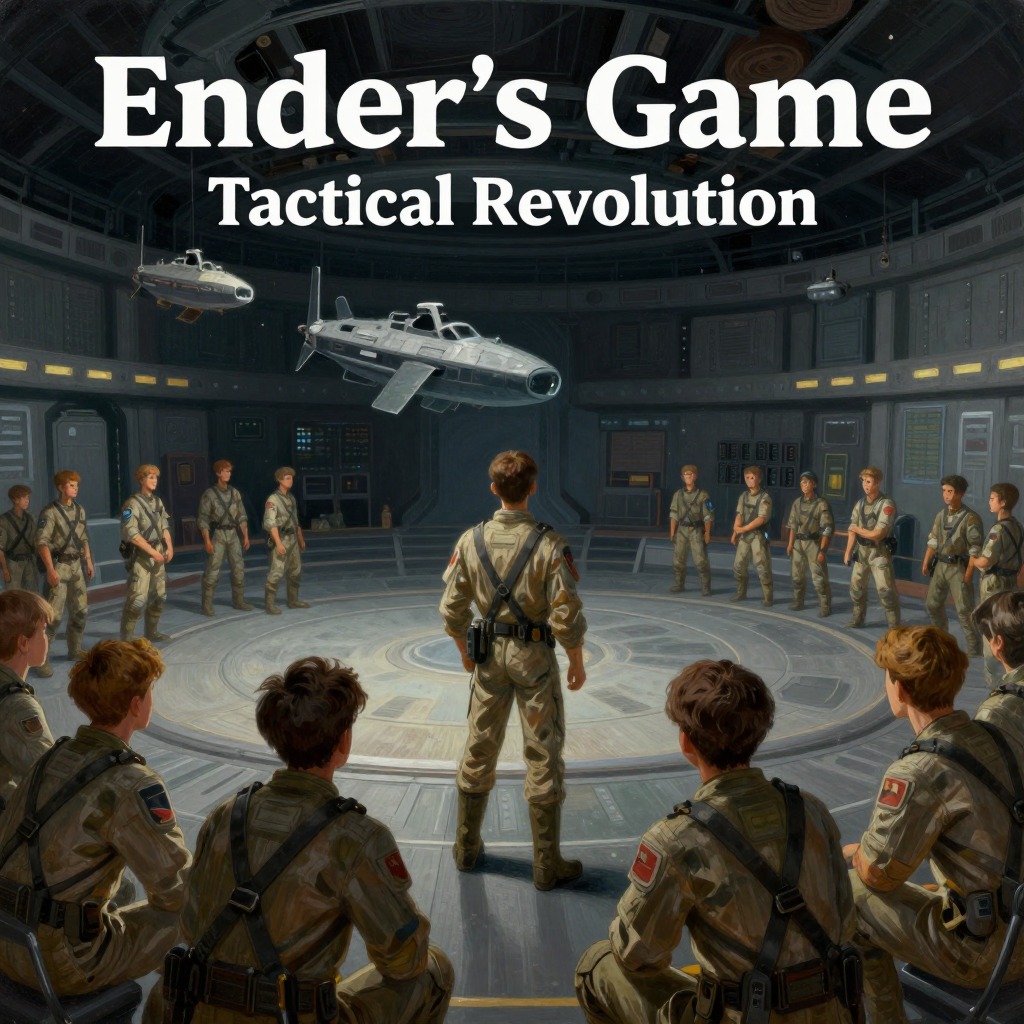
Ender Wiggin's battle against two armies, Griffin and Tiger, stands as the most audacious and rule-defying engagement of his time commanding Dragon Army at Battle School. Facing overwhelming numerical disadvantage and a deliberately rigged scenario, Ender abandoned conventional tactics entirely, choosing instead to win by ignoring the enemy and striking directly at the enemy's gate—a move that inverted the very logic of the game and forced a redefinition of victory. This battle, fought on the same day as his brutal shower confrontation with Bonzo Madrid, marked the breaking point of Ender's endurance and the culmination of his tactical genius, leading directly to his premature graduation and transfer to Command School.
The Rigged Setup and Ender's Despair
The battle was announced on a slip of paper left on Ender's floor, a full-sized sheet of orders rather than the usual internal notice, signaling its extraordinary nature. It came at 1900, after Ender had already fought a grueling morning battle against Pol Slattery's Badger Army, and only hours after he had nearly killed Bonzo in the bathroom. The teachers, having exhausted single-army challenges, now threw two armies at him simultaneously: William Bee's Griffin Army and Talo Momoe's Tiger Army, a combined force of eighty-two soldiers against Dragon's forty. The battleroom itself was rigged: four stars clustered just three meters from the door, completely blocking Ender's view of the enemy, while the room was dimly lit, making it nearly impossible to track enemy movements. Ender, exhausted and emotionally shattered, felt despair. He had not slept, his bed was still wet from his earlier tears, and he had just told his army, "The game is over." When he saw the setup, he thought, "Everything they can do to beat me... they don't care, just so they beat me. Well, I'm sick of the game. No game is worth Bonzo's blood pinking the water on the bathroom floor. Ice me, send me home, I don't want to play anymore."
Bean's Reconnaissance and the Decision to Cheat
Before committing his forces, Ender deployed his most brilliant soldier, Bean, to scout the enemy position. Bean, using a length of twine he had developed in practice, launched himself through the door in a series of impossible arcs, changing direction mid-flight by wrapping the twine around the stars, making himself an untargetable blur. He returned with a report: the enemy had eight stars arranged in a square around their door, and they were simply waiting, confident in their overwhelming force. The enemy taunted them, shouting, "Hey! We be hungry, come and feed us! Your ass is draggin'! Your ass is Dragon!" Ender's mind felt dead. He knew that in a real war, any commander with brains would retreat, but Bean reminded him, "It's only a game." Ender replied, "It stopped being a game when they threw away the rules." Bean's response was simple and profound: "So, you throw 'em away, too." This crystallized Ender's decision. He grinned and said, "OK. Why not. Let's see how they react to a formation." It was a deliberate act of rebellion, a decision to cheat as the teachers had cheated, to win on his own terms or not at all.
The Formation and the Feint
Ender formed his army into a bizarre, unprecedented formation: a square wall of tightly-packed bodies in front, and behind it a cylinder of six boys in circumference and two boys deep, their limbs outstretched and frozen, held together by twine. From inside this formation, Dragon Army fired with deadly accuracy, forcing the Griffins and Tigers to stay tightly packed on their stars. The enemy commanders, William Bee and Talo Momoe, argued about whether to attack. Momoe wanted to use their overwhelming force, but Bee cautioned, "Sit tight and we can't lose, move out and he can figure out a way to beat us." They sat tight, watching the strange formation. When the formation abruptly reversed direction and headed back toward the Dragon gate, Bee realized something was wrong—the formation couldn't have reversed without a powerful push, and that push must have sent a small group of soldiers flying toward the enemy's door. Indeed, six small Dragon soldiers, including Bean, had been launched from the formation, and they were now down near the enemy's gate, unnoticed in the chaos.
The Victory Ritual and the Aftermath
While the bulk of Dragon Army was being destroyed, Bean and his squad reached the enemy's door. William Bee, seeing them, casually aimed at them, but nothing happened—the game was over. The lights went on. Four of the Dragon soldiers had their helmets pressed on the corners of the door, and one had just passed through, completing the victory ritual. They had won, not by destroying the enemy, but by performing the ritual that ended the game, a move that was technically legal but had never been attempted because it required ignoring the enemy entirely. Major Anderson, who had entered the room, was forced to acknowledge the victory, though he immediately announced that the rules would be revised to require all enemy soldiers to be frozen or disabled before the gate could be reversed. Ender, defiant, shouted, "What is it next time? My army in a cage without guns, with the rest of the Battle School against them? How about a little equality?" The other boys, even the defeated enemies, murmured in agreement. William Bee himself answered, "Ender, if you're on one side of the battle, it won't be equal no matter what the conditions are." The boys clapped and shouted Ender's name, a rare moment of universal respect. But Ender was done. He told his army, "The game is over," and walked away, leaving his command behind.
Significance and Consequences
The battle was a turning point in Ender's career and in the history of Battle School. It demonstrated that Ender's genius lay not in following rules but in transcending them, a quality that the teachers had cultivated but could not control. The victory, achieved through a combination of Bean's innovative reconnaissance, Ender's willingness to sacrifice his army, and a profound understanding of the game's mechanics, was a direct challenge to the authority of the teachers. It forced a rule change, but more importantly, it signaled to the entire school that Ender was unbeatable by conventional means. The battle also marked the end of Ender's emotional resilience. He had already been pushed to the brink by the bathroom fight, and this engagement, fought on the same day, broke his will to continue. When Bean came to his room afterward to report that he had been transferred to command Rabbit Army, Ender told him, "I don't care about their game anymore. I'm not going to play it anymore. No more practices. No more battles." This decision, and the teachers' recognition that they could push him no further, led directly to his graduation and transfer to Command School, where he would face the real war against the buggers. The battle thus stands as the final, defiant act of Ender's childhood, a moment of triumph that was also a surrender to the forces that controlled his life.